
Harvesting Bush Rafter Posts
Harvesting bush timber for rafter support posts is a pretty satisfying way to get sturdy, local materials for new projects, especially if you’re working off-grid. When I set out to build a 60m² shed, I needed support posts that were tough and straight enough to handle a serious load. Here’s how I tackled the whole process of harvesting bush rafter posts, from picking the right trees to prepping the posts for eventual burial in the ground.In this article, i hope to share with you, my own best practices for harvesting rafter posts.Do read on and enjoy.
What I Needed for My Shed

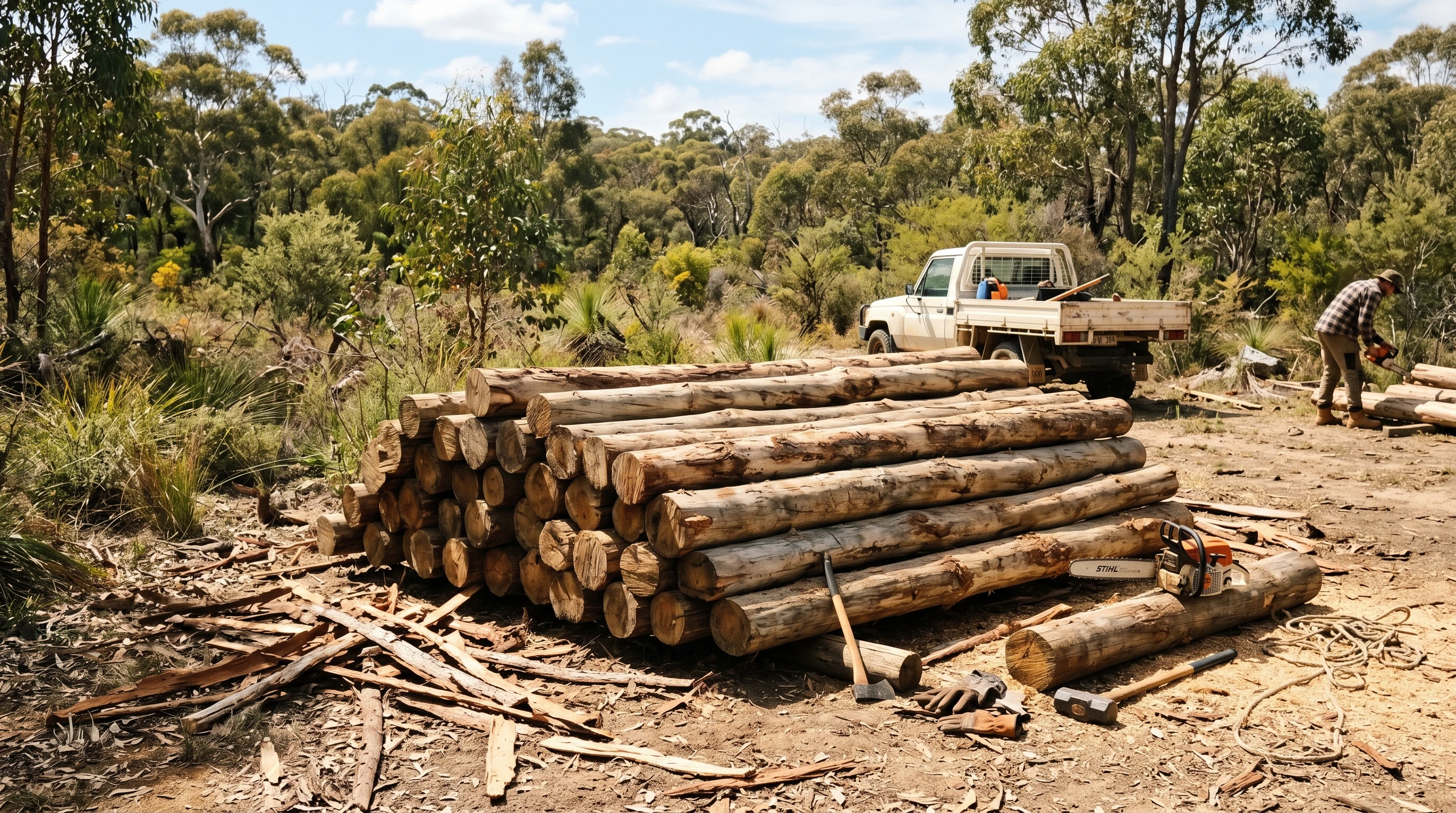
I was aiming to put up 12 rafter support posts for my off-grid shed, and they needed to be at least 4 meters long and about 200mm thick to cope with the roof’s weight and span. For this kind of job, you need timber that won’t bend or twist over time, and it helps if you can source it yourself to keep costs in check.I settled on two timber species I really trust: Cape York bloodwood (Corymbia polycarpa) and Darwin stringybark (Eucalyptus tetradonta). Both are renowned as solid Australian hardwoods. Their trunks are usually super straight, and they stay that way even after drying out and being treated. I noticed one thing when I was out looking for a preferred type and size of tree. Once I found what I was looking for, it was usually surrounded by more of the same size and type. I am no ecologist, but this was just a pattern I noticed when out and about.
Choosing and Checking the Right Trees
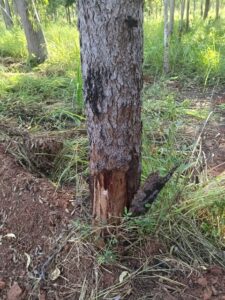
If you want a truly straight post, you’ve got to do more than just glance at a tree. Stand back and eyeball the trunk from top to bottom, sizing it up for any visible bends or twists. Move around the tree and check from four observation points at 90-degree intervals. (Imagine a clock face showing the 12,3,6,9 positions). This is my go-to system for getting a complete picture. If the trunk looks straight at every point, you’re looking at a strong candidate.

I also pay attention to trunk thickness. Keep in mind that the post will be smaller once you strip the bark off and after drying due to moisture loss, so either estimate or cut into the bark to check its depth. If the trunk is 220mm across and the bark is about 10mm thick all around, then when you skin off the bark, your post ends up pretty close to 200mm. Here is my “bush “formula to determine finished post thickness: trunk width-(2 x bark depth)=finished post width. I hope this bush maths makes sense. This quick calculation helps avoid any nasty surprises after harvesting.
Safe Tree Felling: Preparation and Approach
Safety is not just a buzzword when you’re out with a chainsaw in the bush. I make sure my tools are serviced and sharp, and I always suit up with a hard hat, heavy-duty gloves, steel-toe boots, hearing protection, and suitable personal protective equipment. Out here, surprises include more than just a falling tree. Bush hornets, wasps, and even the odd snake have caught me unawares at times, and a bit of mozzie spray doesn’t hurt either.
Before making any cuts, check the tree for potentially loose and broken branches overhead, so-called “widow makers”.Also, clear any folks, vehicles, equipment, or other trees from the path you want to make the tree to fall. Other trees, even saplings, are sometimes able to “catch” a falling tree, thereby leaving a fallen tree half fallen, which then becomes another problem.
Another issue to watch out for is the weather and the wind force and direction. Obviously, the less the wind, the better control you will have over where the tree will fall. Next step is to spray-paint a guideline for the cut around the diameter of the trunk at the height off the ground that suits you. From this baseline, mark where to carve out a 45-degree wedge in the trunk. The open side of the “wedge” should point in the direction you want the tree to fall.
Make sure there’s a clear exit path for yourself away from the base of the tree in case you have to exit quickly away from the tree while cutting/ felling.
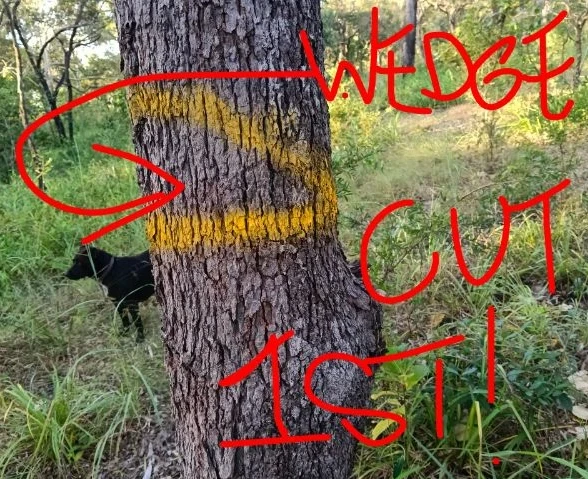
Once I’ve cut the wedge, I move around to the back and make a horizontal cut toward the “sharp” end of the wedge.
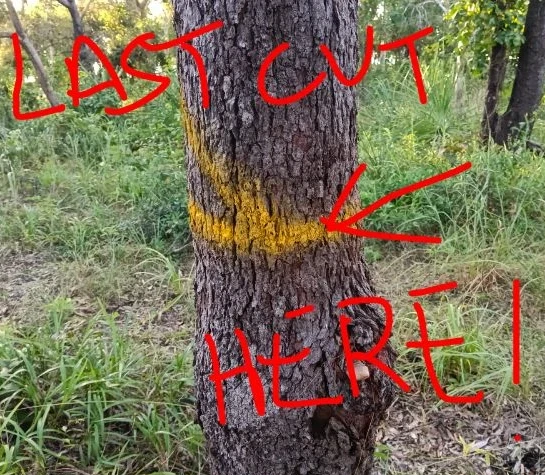
This last horizontal cut will be enough to “break the back” of the tree and make it start to fall in the direction the wedge is facing. Patience and a steady approach go a long way here. It’s also a good idea to step back frequently and survey your surroundings to make sure nothing has changed. Here is another tip for staying safe. Don’t ever go to work, thinking nothing can go wrong today. From the time you “clock on” to going home is the time to switch on, always.
Cutting, Collecting, and Transporting the Posts
After the tree is down, I measure and cut the trunk to the required length, making sure I get that 4-meter minimum. Getting these hefty posts out of the bush can take a bit of muscle or a sturdy winch. I used rope to tie a couple of half hitches around the smaller diameter end of the fallen trunk and basically dragged the posts out of the scrub to a trailer I had nearby. I can tell you now, any post longer than 4m @ 200mm diameter will only be moved with a winch, vehicle, or an extra set of hands. It was hard work, but pretty rewarding when I got the raw product back to the building site.
Barking and Drying the Posts
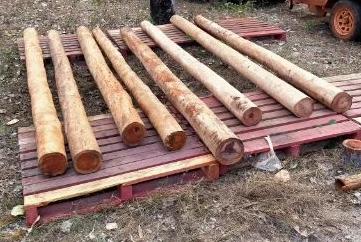
Bark might keep the tree alive in the bush, but for construction use, it’s just going to slow down the drying process and attract bugs. I usually lay the trunks flat and peel off the bark with an adze, but a claw hammer works too. If you hammer along a marked line lengthwise, the bark starts to peel away in satisfying strips, exposing the clean timber underneath.
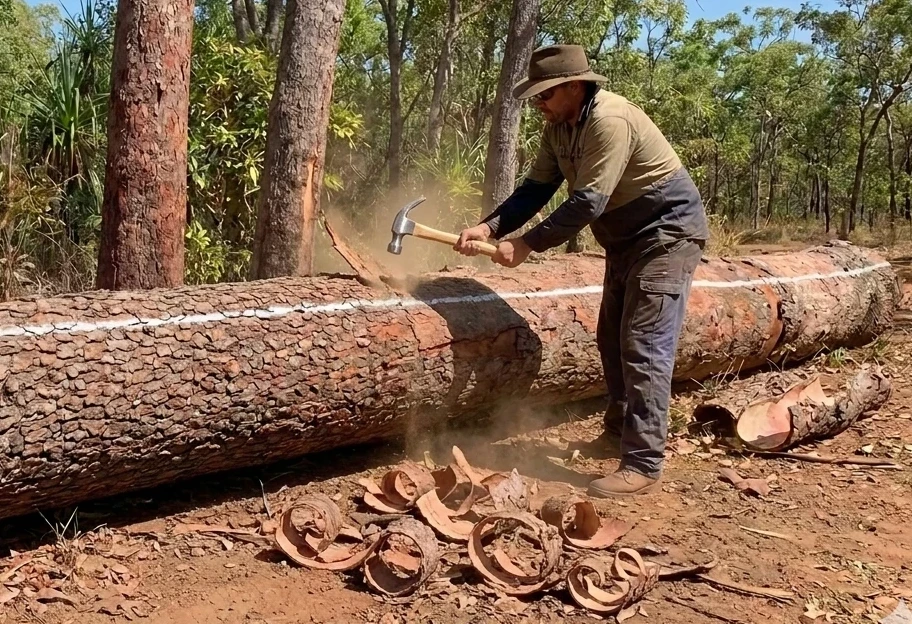
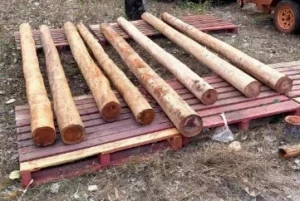
After barking, it’s really important to let the timber dry. I stack my posts off the ground—usually between two old pallets—which keeps air circulating and speeds up the drying time. A bit of time in the sun for two weeks to a month or longer, whichever is preferred, helps ready the posts for any treatment or finishing work. Make sure to rotate the posts every few days to prevent one side from getting too much sun and possibly cracking. I am located in Northern Australia, which experiences a “dry” season(May to October) and a “wet” season(November to April). I found it best to do this harvesting in the dry season. This helps with collecting and drying timber a lot. Obviously, if it were during the wet season, this would hinder drying times, etc. Proper drying both preserves the wood and makes it much easier to apply treatments later.
Treating Posts Against Termites
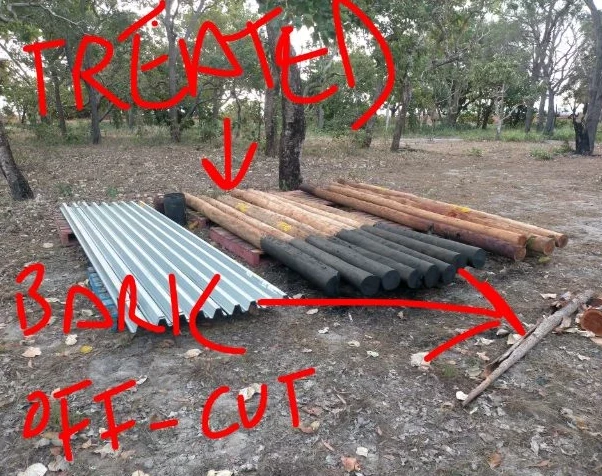
Once the timber has had a good drying period, you’ll want to treat the ends, especially if your posts will be buried. I use a homemade termite treatment that does the trick without splashing out on chemicals. It’s just old engine oil mixed with diesel in about a 70:30 mix. i.e 70% engine oil/30% diesel. If no diesel is available, old engine oil on its own will suffice. Brush or paint it onto the ends of the buried section of the posts. This will give decent protection from white ants and termites, which are prevalent in Cape York Peninsula. This can be applied by roller or paint brush at least once per week after the drying process. Apply a minimum of 2 coats per post. I think I actually applied about 5 coats per post end. You will soon see the absorption into the wood as you apply each coat, with the post getting darker after each coat. You can also clearly see the absorption into the wood by looking at the cross-sectional end of the post. You should be able to see how far the oil has penetrated the wood from there.
Ready for the Build
At this point, you’ve got strong, straight, seasoned posts that are ready to be put to work. Whether you’re building rafters, uprights, or any other structure, harvesting your own bush timber gives you a lot more control over quality and cost. Plus, there’s real enjoyment in seeing your shed or shelter supported by posts you found, prepped, and cut yourself. Every notch, scrape, or mark tells a story of the hands-on work you put in to make your project a reality. Not only that, but harvested bush timber certainly has character about it once installed.
Common Timber Harvesting Questions
People often ask about best practices or what’s most sustainable, so here’s how I usually break it down:
What are the three approaches to timber harvesting?
The three methods are clear-cutting, selective cutting, and shelterwood cutting.
Which is better, clear-cutting or selective cutting?
Selective cutting tends to be better for the environment because it keeps more of the ecosystem intact while still providing useful wood. Clear-cutting is faster but can be rough on the land in the short term. For bush projects, selective cutting is usually more practical, especially if you’re just after a few straight, quality posts.
Which timber harvest method results in an uneven-aged forest?
Selective cutting creates an uneven-aged forest by allowing trees of varying ages to remain and grow, while clear-cutting results in forests where most regrowth is the same age.
What is the best tree harvesting method?
There’s no single answer, since it depends on your goals. For off-grid projects like mine, a selective approach is most practical. You find and remove only what you need and leave the rest alone. On bigger commercial sites, shelterwood or clear-cutting have their place, usually balanced by local regulations.
Final Tips for Harvesting Bush Rafter Posts
Harvesting your own bush timber takes time and patience, but the payoff is real. Straight, strong posts make all the difference in a building’s strength. Always keep safety front and center, and take a bit of pride in knowing exactly where your materials came from. You don’t just end up with sturdy rafter posts. You get the satisfaction of building with your own hands. That’s something timber from the hardware store just doesn’t match. I hope my article was able to share some handy tips with you.Please do comment below on any questions or opinions you may have.


Really interesting read I liked how practical and straightforward the explanation was about selecting and harvesting bush rafters and posts. It’s easy to overlook how important choosing the right trees and letting the wood cure properly can be for the strength and lifespan of a structure.
I’ve helped with a small outdoor shelter project before, and peeling and handling the posts ended up taking way more time than expected, so I appreciated the realistic approach in this article. Do you usually prefer harvesting green timber and drying it yourself, or sourcing already seasoned poles when possible? I’d also be curious to hear how different wood species have held up for you over time in outdoor conditions.
HI Iyere, thanks for your comment here.Yes i definitely prefer harvesting wild timber,theres so much good in the process e.g. being out bush in the quiet,the wood is free,bush timber has real character and charm.I have only ever tried this bloodwood and stringybark so far and i can tell you that 5 years on the posts are still standing strong with no sign of termite damage as yet.
This was such a thoughtful and practical post. My husband works in carpentry and often harvests bush timber himself, so I really appreciated the reminder about safety when using a chainsaw. In our area, there have sadly been several accidents; one man we know personally was paralyzed after a tree fell on him. Reading your emphasis on preparation, awareness of surroundings, and having a clear exit path really hit home.
It makes me wonder, from your experience, what’s the single most overlooked safety step that people tend to skip when felling trees, even though it could prevent serious accidents?
Thanks for your comment Celia.The single most overlooked safety step in any industry is people thinking “it wont happen to me”.They take the attitude to work and the next thing they know is it has all gone bad very quickly.
What a genuinely practical and honest walkthrough of a process most off-grid guides completely gloss over. The level of hands-on detail here, from the four-point trunk inspection method to the bush formula for calculating finished post thickness, is exactly the kind of hard-won knowledge that only comes from actually doing the work.
The termite treatment using old engine oil and diesel is a brilliant, low-cost solution I hadn’t come across before. Five coats make perfect sense given how visibly the wood absorbs each application, and monitoring penetration through the cross-section end is a smart verification method.
The safety advice feels genuinely personal rather than just obligatory. Bush hornets and widow makers in the same paragraph as chainsaw technique is real bush experience talking.
The observation about trees of the same size clustering together is fascinating. I would love to know whether you’ve found that pattern consistent across different species, or only with bloodwood and stringybark specifically.
Brilliant read from start to finish. Saving this for reference!
Hi Andrejs, thanks very much for your insightful comment here. Much appreciated.I definitely have noticed that pattern r.e: tree clusters, similar sizes and types in other types of trees/saplings, etc. as well. As i said in the article, i am no ecologist or academically trained tree person, these are just patterns I noticed in the bush in the quiet surrounds.