
My Water-during Wet And Dry Season.
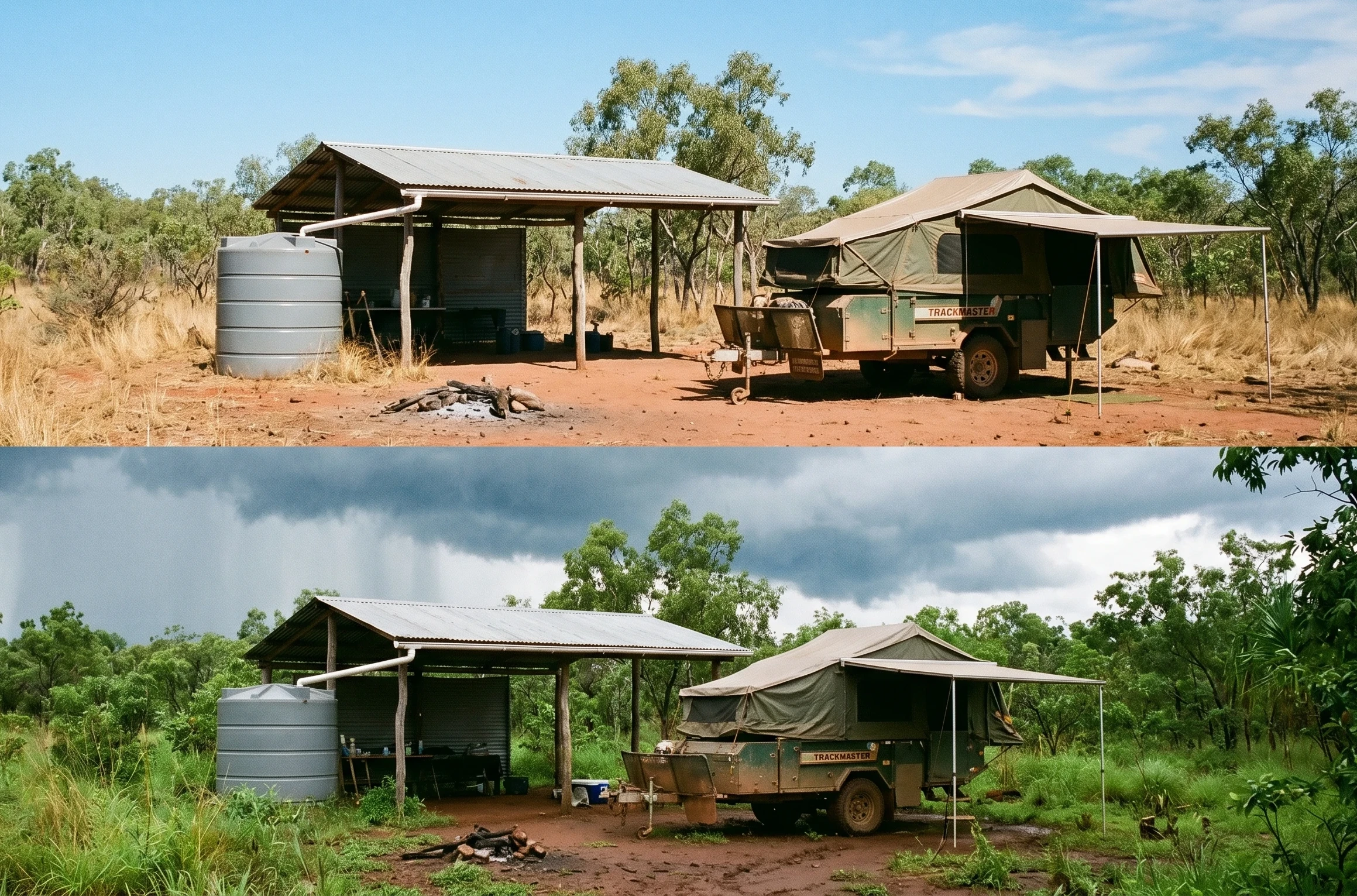
Living off-grid in Northern Australia comes with a few unique challenges and rewards, especially when it comes to water. I rely on two main sources for all my needs; one for the dry months, and another once the wet season hits. Getting my water isn’t just about drinking—it’s about off-grid water storage, washing, showering, doing laundry, and making bush life comfortable year-round. Here’s what my process looks like for both seasons, why each step works, and a few lessons learned in the bush. Another point to note is the 2 distinct seasons we have in Northern Australia.
The Wet Season (Nov–Apr) averages 700mm-2000mm rainfall in this season, due to a monsoonal trough that basically comes and parks itself over the top of Northern Australia during this time.
The Dry Season (May–Oct) median monthly rainfall is 5-25mm, and our seasonal calendar is as follows:
Summer: December, January, February (hottest months)
Autumn: March, April, May
Winter: June, July, August (coldest months)
Spring: September, October, November
Water in the Dry Season: Towing, Filling, and Storing
The Northern Australian dry season can go for months without reliable rain, so I have to bring in every drop I use. My whole setup centers around mobility and storage, built for practicality and reliability. No fancy gadgets, just things that work.
My dry season routine starts with my 1000-litre tank loaded onto a trailer. I hitch it up and drive to the nearest beach, where there’s a public tap with clean town water. With a simple garden hose and standard tap fittings, I fill the tank, using the town water pressure. It usually takes about 75 minutes to fill that 1000-litre tank, so I walk back to my camp and do some other chores while it fills. Once the tank is full, I tow it back to camp and pump the water into my on-site storage—another 1000-litre tank set up there. For all water transfers at camp, I rely on a 240V, 600-watt electric pump powered by my 3kVA petrol generator, or “Genny” as we like to call them in Australia. It does all the heavy lifting, so I don’t have to worry about siphoning or waiting for slow gravity drains. It’s fast and efficient, especially when I’m moving a full tank’s worth of water around.
I break my water supply down further by transferring about 400 litres from the ground storage up to a tank positioned on my roof. The roof tank acts as my header, gravity feeding down to taps for my kitchen, laundry, shower area, and straight to my outdoor woodfired water heater near the shed. This setup keeps water pressure simple; no complex plumbing, just some 3/4″ plumbers copper, a few bends, and tee juntions, I installed, and gravity doing its thing. Having water available at these spots means I can shower, wash clothes, or make hot water with no hassle.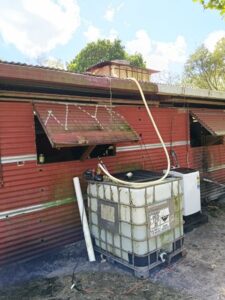 A full 1000-litre tank lasts me about 14 days if I’m careful. That covers everything: showers, washing up, laundry, and the basics for day-to-day living. With some planning, I refill about every two weeks, making as many trips as is necessary over the course of the dry spell. There are 2 things I have learned about water, when living like this:
Never take water for granted. Wherever I am, out bush or in a city, whenever I see a water source, like a creek out bush or a stream in a city park, I always think to myself, man, I could use that water somewhere!
Water is actually a powerful and precious survival tool for people in all aspects of life! Without it, we are “stuffed” as we like to say in Australia!
Water in the Wet Season: Rain Catchment and Storage
When the wet season arrives, I switch from relying on town water to catching and storing rainwater. Rain becomes my sole source; no more towing tanks and relying on town water. The switch is a relief and a bit of a challenge all at once because monsoonal weather patterns can be a bit unpredictable. I learned the trick here is to keep an eye on the weather and keep the roof gutters clean, and that usually keeps me supplied with water for months during the wet.
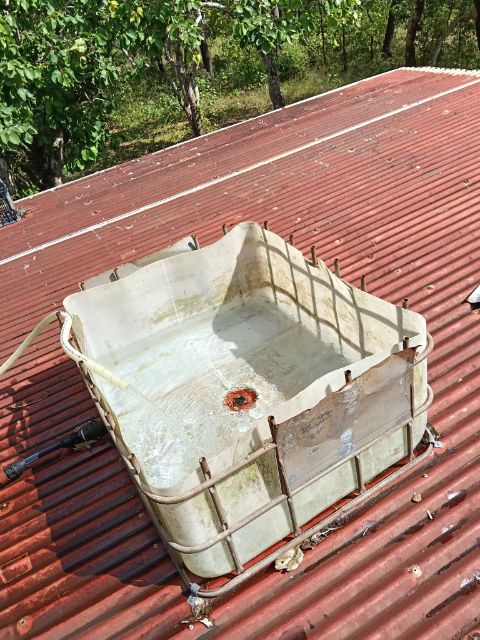
The big switch happens right on my shed’s roof, which is about 60m2. I’ve set up basic guttering that channels every drop of rainwater into my ground-level storage tank. With the torrential downpours of the monsoonal season, these tanks can fill up much faster than any garden hose ever could. A single heavy storm can fill one 1000 ltr tank in 30 minutes and the second 1000 ltr tank in another 30 minutes if it keeps going, but only if the gutters are clear and nothing is stopping the flow.
Once the storage tank is topped up, the routine mirrors what I do in the dry season. I use the electric pump to transfer around 400 litres up to the roof tank, then that gravity feeds down to taps at all my essential areas as discussed previously. The biggest difference during the wet is that I never have to worry about running low, as it doesn’t take much rain to top up both tanks again.
Having independence from town water during the wet is fantastic. The rain is pure and soft, perfect for everything from making a cuppa to a long shower. My only real work is clearing the gutters, cleaning screens, and keeping the system free from leaves and muck, but even that only takes a few minutes after big storms. With some days bringing steady rain and others just a passing shower, I always keep an eye on water levels and weather forecasts to match my use with whatever falls from the sky. That way, I am always prepared to stretch my supplies just a bit longer to make it through until the next monsoonal burst.
Core Gear and How It All Works Together
The off-grid water game isn’t about fancy tech, but about rugged gear that does the job. Here’s a quick list of what keeps my system ticking:
1000-litre Poly Water Tanks: Two main tanks onsite; one mobile, one stationary. Polytanks are tough enough for the bush, can handle being moved, and won’t rust or crack under the tropical sun.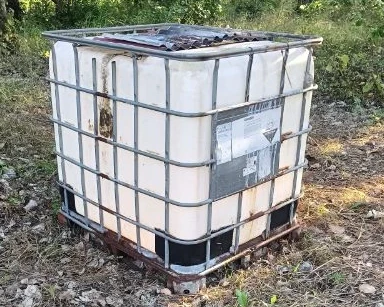
400-litre Roof Tank: Works as my gravity feed source. Lighter and easier to rig on the roof than a big tank. Simple design keeps water pressure up with no electric pumps running nonstop.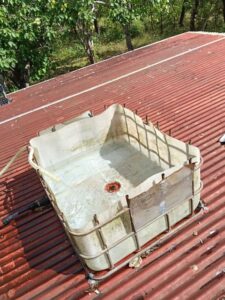
Electric 240V Pump: Handles all water transfers between tanks. Since I rely on solar and generator power, I picked a unit that’s efficient but strong enough to move full tanks of water.

Roof Guttering and Simple Filters: Basic guttering and one downpipe run off my shed roof. Mesh screens keep out the worst leaves and debris, so I don’t get leaves going into a tank.
Hose and Tap Fittings: Garden hoses with proper connectors work for collecting and transferring water.
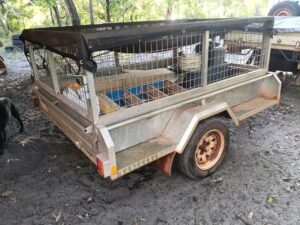
2.5m x 2.5m box trailer for towing tanks.
Off-grid water storage maintenance tips
Out here, water isn’t just a convenience—it’s something I think about daily, especially when supplies are tight. Making it last comes down to a few practical routines.
Bulk Transfers and Topups: Pumping water in larger batches means I’m not running little pumps all day or juggling hoses all the time. With a set schedule, I only transfer when needed, keeping the process efficient.
Basic watersaving:
Keep all taps off when not in use, and make sure there are no leaks anywhere in the shed plumbing system.

Be forever conscious about all water use, wether its necessary or not.
Routine Maintenance: Keeping tanks clean, making sure mosquito screens are sealed.
Failure to do any of the above in relation to your water supply, and you are just asking for more problems!
Common Questions About My Water Setup
Is town water safe to drink out here?
Town water from the tap at the local beach is treated and safe to drink. I still keep an eye on local notice boards and community updates, just in case there are any supply issues.
Is the rainwater safe to drink?
Rainwater is always safe to drink if you follow these simple rules:
Boil all rainwater before drinking at all times; e.g., boil, cool, and drink, or boil and drink straight away (e.g., tea, coffee, etc.).
Keep gutters, tanks, and anti-leaf mesh clean at all times to ensure good, clean flow into the tanks.
How do I keep my water tanks clean?
I rinse out all my tanks at the start and end of each season. I don’t have mesh over the guttering, but i do have it on top of each tank where the downpipe comes in.
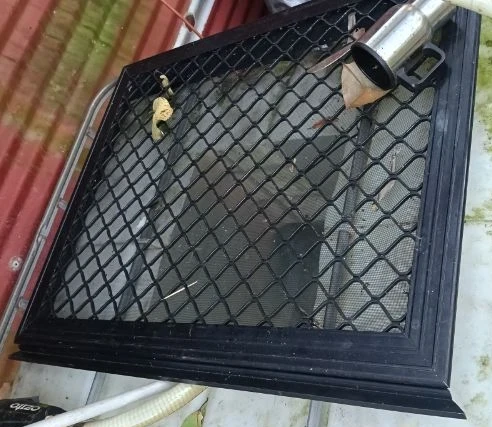 I just use a leaf blower on the roof in the guttering when cleaning. It’s an excellent, “lazy” way to clean gutters without getting down on hands and knees on the roof, plus it’s quick to do! During the wet, I make sure the guttering and mesh screens stay clear of leaves and remove any buildup inside the tanks.
Can the system go totally hands-free?
It’s possible with sensors and float switches, but I like to keep things simple; fewer moving parts, less to go wrong. Manual checks and a hands-on approach are just as good at keeping on top of things where my water supply is concerned.
Lessons From Both Seasons
Living with water as my own responsibility helps me appreciate every drop. Simple maintenance, like clearing gutters and keeping mesh screens clean, pays off by helping the system run without fuss. If there’s one big takeaway, it’s that off-grid water isn’t a one-size-fits-all thing. Build what works for you, keep it tough and simple, and you’ll have everything you need, rain or shine. Whether you’re just starting off-grid life or thinking about fine-tuning your own setup, staying flexible and prepared makes all the difference. Out bush, water is everything, and with the right approach, you can keep things flowing all year long. If you have any comments or thoughts r.e this article, please leave them below in the comments section. I would love to see them. Thanks.


This is an excellent and practical overview of off-grid water management in Northern Australia. I particularly appreciate your emphasis on simplicity, routine maintenance, and adapting your system to the distinct wet and dry seasons. Your firsthand experience highlights just how valuable water becomes when you are responsible for sourcing and storing it yourself. Thanks for sharing these real-world insights. They will be very helpful for anyone considering an off-grid lifestyle.
Thanks Kavitha for your thoughts r.e. this article.
Wow, you have to become so resourceful when living off of the grid, just as you have had to do. It must be rewarding though when you see just how good you are at surviving without having to rely on somebody else to provide this precious resource.
We are also the lucky owners of about ten tanks, so we hardly ever run out of water, unless it is a really dry season. How do you keep the mosquitoes from breeding in your tanks? We find this problematic from time to time.
Thanks for your comment Michel.I can’t say I have paid much attention to mosquitos breeding in my tank water.I generally go on the clarity of the water that i have and pretty much know straight away as my tanks are opaque but you can still see if its getting darker etc.The other thing that i do is boil any water in my tanks before drinking any of it.By doing that,i am pretty confident that takes care of any mosquitos in my water.
I can totally relate to your experience. Where we live, water becomes a real challenge during summer, and it’s taught me to value every single drop. Back when I was still living with my mom, water was never an issue; we always had enough throughout the year. But now, especially during the dry months, I find myself being extra mindful, whether it’s reusing water when possible or making sure nothing goes to waste.
Your setup really highlights how much planning and effort goes into managing water off-grid. It made me reflect on how easily we can take it for granted until we’re faced with scarcity. Do you find that living this way changes how you view water even when you’re in places where it’s abundant?
Hi Leica, thanks for your comment here.The way i live out bush in relation to water definintely affects how i look at water elsewhere.As i stated in my article,every time i see a water source in the city or out bush,I always think about where i could use that water elsewhere.